
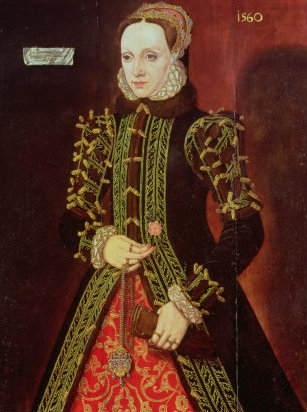
Elizabeth Grey, Countess of Kildare (c.1497- after 1548), was an English noblewoman, and the second wife of Irish peer Gerald FitzGerald, 9th Earl of Kildare. Her father was Thomas Grey, 1st Marquess of Dorset.
She went to France in 1514 as one of the Maids of Honour of Mary Tudor, Queen of France, and remained to serve the latter’s successor, Queen Claude, in the same capacity.
Family and early years:
Lady Elizabeth Grey was born in about 1497, a daughter of Thomas Grey, 1st Marquess of Dorset, and Cecily Bonville, Baroness Harington and Bonville, one of the wealthiest heiresses in England in the latter half of the 15th-century. Elizabeth’s paternal grandmother was Elizabeth Woodville, Queen consort of King Edward IV of England.
Elizabeth had 13 siblings, including her eldest brother Thomas Grey, 2nd Marquess of Dorset, who succeeded their father when he died in September 1501, when she was about four years old. Two years later, their mother, Cecily married Henry Stafford, 1st Earl of Wiltshire, which caused many quarrels over their inheritance. On one occasion, Cardinal Thomas Wolsey was forced to intervene on behalf of King Henry VIII of England, and he ordered both Cecily and Thomas to contribute to the dowries of Elizabeth and her three surviving sisters.[1]
She was appointed one of the Maids of Honour to Princess Mary Tudor in 1514, and accompanied her to France when the princess set out to marry King Louis XII. She remained at the French court when Queen Mary’s other English ladies were sent home, and stayed on to serve Mary’s successor, Queen Claude, consort of the new King Francis I, in the same capacity. Elizabeth’s fellow English Maids of Honour, who also were allowed to remain behind in Queen Claude’s household, were Anne Boleyn, and Mary Boleyn.[2]
Elizabeth was one of Queen Catherine of Aragon‘s attendants at the Field of the Cloth of Gold in 1520.
Marriage and issue:
She married Gerald “Gearóid Og” FitzGerald, 9th Earl of Kildare in London in about 1522. His first wife, Elizabeth Zouche had died, leaving him a son, Thomas, and three daughters. By his marriage to Elizabeth, who was Henry VIII’s cousin, Gerald gained much influence at court.[3] Elizabeth was styled as the Countess of Kildare. The match, while advantageous to Gerald, was also partially based on the physical attraction the couple had for one another. Historian Mary Anne Everett Green described Gerald as having been quite handsome in appearance, and he in turn was pleased by Elizabeth.[4] He had been a kindly husband to his first wife, and his second marriage was also happy.[5] According to historian Barbara Jean Harris, Elizabeth married Gerald against her father’s will; however in 1527 her mother forgave her by granting Elizabeth a dowry of £1000. She added the following as means of explanation for the money: “forasmuch as the said marriage is honourable and I and all her friends have cause to be content with the same”.[6]
In 1523, Elizabeth returned with her husband to Ireland, where he served as Lord Deputy of Ireland (1524–1525, 1532–1534), and as Deputy to the King’s Lieutenant of Ireland (1533).[7] Extant letters she wrote home to England, show that Elizabeth had taken a keen interest in the Irish political situation.[8]
Together Gerald and Elizabeth had at least six children:
- Lord Gerald FitzGerald, 11th Earl of Kildare, known to history as “The Wizard Earl”, (25 February 1525- 16 November 1585), married Mabel Browne, by whom he had issue.
- Lady Elizabeth FitzGerald, known as “The Fair Geraldine” (1527- March 1590), married firstly, Sir Anthony Browne (d.1548), by whom she had two children who both died young; and secondly Edward Clinton, 1st Earl of Lincoln. Her last marriage was childless.
- Lord Edward FitzGerald (17 January 1528 – 1597), married Agnes Leigh, by whom he had issue, including Gerald FitzGerald, 14th Earl of Kildare.
- Lady Mary (or Margaret) FitzGerald,[7] married Richard Nugent, 3rd Baron Delvin, by whom she had issue.[9]
- Lady Anne FitzGerald
- Lady Catherine FitzGerald (died after 7 April 1547), who married firstly Jenico Preston, 3rd Viscount Gormanston; and secondly Richard St Lawrence, 7th Baron Howth.
In 1531, a private Act of Parliament assured her an income of £200 per annum as well as the Irish manor of Portlester.[10]
In October 1533, Elizabeth brought her daughter, Elizabeth FitzGerald to the English court. The girl, aged six, became a companion to the infant Princess Elizabeth, daughter of King Henry VIII, and Elizabeth Grey’s erstwhile companion at the French court, Anne Boleyn, whom the King had married in January of that year.
Later, Elizabeth Grey was allegedly part of the conservative faction at court who plotted against Queen Anne.[11]
Elizabeth’s husband, the Earl of Kildare, who was imprisoned in the Tower of London on charges of corruption and plotting rebellion in Ireland, died in 1534. Elizabeth had remained with him, nursing him throughout his imprisonment from July 1534 until his death on 12 December. The Earl had received a gunshot wound at the end of 1532 in an attack he had led against the O’Carroll clan at Birr.
Elizabeth retired to her brother Leonard’s manor of Beaumanoir, in Leicestershire, while her younger sons were raised at court alongside Prince Edward. Later her son, Edward joined her.
Rebellion in Ireland:
Elizabeth’s stepson, “Silken Thomas” and her five brothers-in-law were executed for rebellion at Tyburn in 1537. Her own brother Leonard Grey, 1st Viscount Grane, the incumbent Lord Deputy of Ireland had put down the rebellion. Her eldest daughter, Elizabeth was sent to the household of Princess Mary at Hunsdon, and it was during that time that the poet Henry Howard, Earl of Surrey would immortalise the ten-year-old girl as “The Fair Geraldine” in his sonnet, The Geraldine which he wrote while he was briefly imprisoned for striking a courtier.
Her eldest son, Gerald, who could not succeed to the earldom of Kildare as a result of its having been forfeited to the Crown, immediately went on the run in Ireland, where in County Tyrconnell, along with other disgruntled clans, formed the Geraldine League. When the federation was defeated in Monaghan in 1539, he fled to the Continent. As a result of Gerald’s successful escape, Leonard Grey was attainted and executed for High Treason in July 1541 at the Tower of London by the orders of Henry VIII. Gerald first went to France, and then Italy, where he would remain until his return to England in 1548, in the company of Elizabeth’s chaplain. He was received at court by the new King, Edward VI, who returned his confiscated lands. He succeeded to the title of 11th Earl of Kildare in 1554 in the reign of Queen Mary. After a career of fluctuating fortunes, he died in London in 1585, technically a free man but forbidden to return home to Ireland.
Elizabeth Grey died on an unknown date sometime after 1548.
References:
- Harris, Barbara Jean. English Aristocratic Women, 1450-1550: Marriage and Family, Property and Careers. Oxford: Oxford University Press. pp.114-115.
- ^ Fraser, Antonia (1992). The Wives of Henry VIII. New York: Knopf. p.121. ISBN 0-679-73001-X
- ^ Marquis of Kildare, The Earls of Kildare and their Ancestors: from 1057 to 1773, 1864, chapter 85, Google Books, retrieved 23-11-09
- ^ Emerson, retrieved 4 October 2010
- ^ Lennon, Colm Sixteenth-century Ireland- the Incomplete Conquest Gill and Macmillan 1994 p.78
- ^ Harris, p.58
- ^ Jump up to:a b http://www.thePeerage.com
- ^ Kathy Lynn Emerson, A Who’s Who of Tudor Women, sourced from Elizabeth Grey’s entry in the Oxford Dictionary of National Biography, retrieved on 23-11-09
- ^ http://www.the Peerage.com
- ^ Emerson, A Who’s Who of Tudor Women
- ^ Earlymodernengland, 20 October 2007, accessed 23-11-09
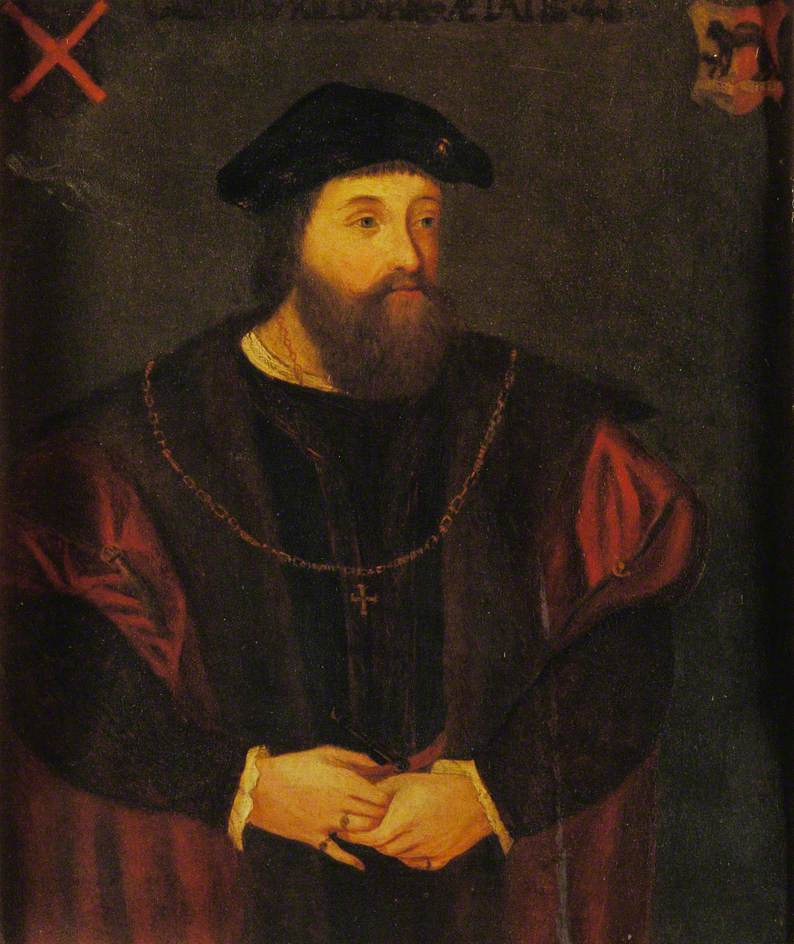
Gerard FitzGerald, 9th Earl of Kildare (1487 – 12 December 1534), also known in Irish as Gearóid Óg(Young Gerald), was a leading figure in 16th-century Irish History. In 1513 he inherited the title of Earl of Kildare and position of Lord Deputy of Ireland from his father.
Family:
He was the son of Gerald FitzGerald, 8th Earl of Kildare and his first wife Alison FitzEustace, daughter of Rowland FitzEustace, 1st Baron Portlester. In 1503, he married Elizabeth Zouche, daughter of Sir John Zouche of Codnor and Elizabeth St John,[1] a first cousin of King Henry VII,[2] with whom he had:
- Thomas FitzGerald, 10th Earl of Kildare and
- Lady Allice/Ellis FitzGerald, who married Christopher Fleming, 8th Baron Slane.[3]. This was her aunt (Lodge I, 87, 92). See also Gerald FitzGerald, 8th Earl of Kildare
He married secondly Lady Elizabeth Grey, who was like his first wife a cousin of the King, though a more distant one, and had a further six children:
- Gerald FitzGerald, 11th Earl of Kildare,
- Elizabeth FitzGerald, Countess of Lincoln,
- Edward FitzGerald,
- Anne FitzGerald,
- Margaret FitzGerald, and
- Catherine FitzGerald, who married firstly Jenico Preston, 3rd Viscount Gormanston; and secondly Richard St Lawrence, 7th Baron Howth.
Biography:
Gerald FitzGerald, 9th Earl of Kildare was born in 1487 in Maynooth, County Kildare. He is referred to in the Irish annals as Gearóit Óge (the Younger Gerald) and as Garrett McAlison, after his mother, Alison FitzEustace, daughter of Rowland FitzEustace, 1st Baron Portlester.
In 1496, Gerald was detained by Henry VII at his court as a hostage for his father’s fidelity.[1] In April 1502, at the age of 15, he played the principal role in the funeral ceremony for Henry VII’s eldest son Arthur, Prince of Wales in Worcester Cathedral.
In 1503, he was permitted to return with his father to Ireland, having married Henry VII’s cousin Elizabeth Zouche.[4] The next year he was appointed Lord Treasurer. In August 1504 he commanded the reserve at the Battle of Knockdoe, where his rashness and impetuosity were the cause of some loss of life. On the death of his father in 1513 he succeeded to the title, and was by the council chosen Lord-Justice. Henry VIII soon afterwards appointed him Lord-Deputy. His brother-in-law, Lord Slane succeeded him as Lord Treasurer.
Some of the Irish chiefs at the end of 1513 having ravaged parts of the Pale, the Earl, early in the following year, defeated O’More and his followers in Leix, and then, marching north, took the Castle of Cavan, killed O’Reilly, chased his followers into the bogs, and returned to Dublin laden with booty. This energetic action was so highly approved by the King that he granted the Earl the customs of the ports in the County of Down – rights repurchased by the Crown from the 17th Earl in 1662. In 1516 the Earl invaded Imayle in the Wicklow Mountains, and sent the head of Shane O’Toole as a present to the Lord Mayor of Dublin. He then marched into Ely O’Carroll, in conjunction with his brother-in-law the Earl of Ormond, and James, son of the Earl of Desmond. They captured and razed the Castle of Lemyvannan, took Clonmel, and in December he returned to Dublin ” laden with booty, hostages, and honour.”[1]
In March 1517 he called a parliament in Dublin, and then invaded Ulster, stormed the Dundrum Castle, marched into Tyrone, and took, the Castle of Dungannon, “and so reduced Ireland to a quiet condition.”[1] On the 6 October of the same year his Countess died at Lucan, County Dublin, and was buried at Kilcullen. Next year, 1518, his enemies having accused him of maladministration, he appointed a deputy and sailed for England. He was removed from the government, and the Thomas Howard, 2nd Duke of Norfolk appointed in his stead. He appears to have accompanied the King to France in June 1520, and was present at “the Field of the Cloth of Gold“, where he was distinguished by his bearing and retinue. On this occasion he met the King’s first cousin, Lady Elizabeth Grey, whom he married a few months afterwards, and thereby gained considerable influence at court.
Reports now came from Ireland that he was secretly striving to stir up the chieftains against the new Deputy. After inquiries, the King wrote to Surreythat, as they had “noon evident testimonies” to convict the Earl, he thought it but just to “release hym out of warde, and putt hym under suretie not to departe this our realme without our special lisense.” He was permitted to return in January 1523.
At about this date he founded the College of Maynooth, which flourished until suppressed in 1538. He signaled his return to Ireland by an expedition into Leix in company with the Lord Mayor of Dublin. Having burnt several villages, they were caught in an ambuscade, and after considerable loss retreated with some difficulty to Dublin. In consequence of disputes and misunderstandings between the Earl of Kildare and Ormond, now Lord-Deputy, they appealed to the King, accusing each other of malpractices and treasons. Arbitrators were appointed, who ordered that both the Earls should abstain from making war without the King’s assent, that they should cease levying coigne and livery within “the four obeysant shires – Meath, Urgell, Dublin, and Kildare, ” that the two Earls should persuade their kinsmen to submit to the laws, and that they should be bound by a bond of 1,000 marks each to keep the peace for one year.
Before long, however, their mutual hatred blazed forth again in consequence of the murder of James Talbot, one of Ormond’s followers, by the retainers of Kildare. Again the Earls appealed to the King, and again commissioners were sent over, who conducted an inquiry at Christ Church, Dublin, in June 1524. Their decision was in the main in favour of Kildare, and an indenture was drawn up, by which the Earls agreed to forgive each other, to be friends, and to make common cause for the future. He was also reconciled with the Vice-Treasurer, Sir William Darcy, a former ally of the FitzGeralds who had become one of Gearóid’s most bitter opponents.
Soon afterwards Kildare was reappointed Lord-Deputy. He took the oaths at St. Thomas Court, his nephew, Con Bacagh O’Neill, carrying the sword of state before him. He then entered into an indenture with the King not to grant pardons without the consent of the council, to cause the Irish in his territories to wear English dress, to shave their “upper berdes”, and not to levy coigne and livery except when on the King’s business, and then only to a specified amount, not exceeding 2d. a meal for horsemen, 1½d. for foot
Next year, 1525, Kildare and Ormond were again at daggers drawn. They appealed to the King concerning a disputed sum of £800 in account between them, accusing each other, as before, of sundry enormities and malfeasances. About the same time Kildare, in accordance with a royal mandate, assembled a large force, and marched into Munster to arrest the Earl of Desmond, making a show of great eagerness, but sending private instructions to the Earl how to keep out of the way. He next turned north, and by diplomacy and force pacified the O’Neills and O’Donnells.
In 1526, he was ordered to England and he took with him his married daughter Alice, Lady Slane so that she could report back on his progress.[5] He was summoned to meet the charges of Ormond (now Earl of Ossory through surrender of the higher title to the King) of having secretly assisted the Desmonds, and having murdered many good subjects because they were adherents of the Ormond and the Butler family. On arrival in London, he was for a time committed to the Tower, and was retained in England for four years; and when he was brought before the council, a violent altercation ensued between him and Wolsey, which is reported at full length by Holinshed. Wolsey is said to have obtained an order for his immediate execution, which his well-wisher, the Constable of the Tower, frustrated by exercising a right (still inherent in the office) of demanding a personal interview with the King. Liberated on bail for a time, Kildare was recommitted on the discovery of his intriguing with the Irish princes to induce them to commit assaults on the Pale, so as to make his return appear necessary. Liberated again, he was one of the peers who in 1530 signed the letter to the Pope relative to the divorce of Queen Catharine.
The same year, to the joy of his retainers, he was permitted to return to Ireland with Skeffington, the new Lord-Deputy. On his arrival he marched against the O’Tooles to punish them for ravages on his tenantry in his absence, and then accompanied the Deputy against the O’Donnells. The friendship of the Deputy and Earl did not last long, and they sent letters and messages to the King accusing each other. The Deputy, as might be expected, was supported by the Butlers.
Nevertheless, the Earl appears to have cleared himself, and to have been appointed to succeed Skeffington as Lord Deputy under the Duke of Richmond, who had been granted the office of Lord-Lieutenant of Ireland. Landing at Dublin in this capacity, in August 1532, Kildare was received with great acclamation. But lengthened peace appeared impossible. He insulted Skeffington, degraded John Alen, Archbishop of Dublin, wasted the territories of the Butlers, and was accused of forming alliances with the native chiefs. In 1533, the council reported to the King that such was the animosity between the Earls of Kildare and Ormond that peace was out of the question so long as either of them was Lord Deputy.
Death:
At this period, Kildare had partially lost the use of his limbs and his speech, in consequence of a gunshot wound received in an attack upon the O’Carrolls at Birr. He was again summoned to court; and in February 1534, at a council at Drogheda, in an affecting speech, he nominated his son Thomas, Lord Offaly, as Vice-Deputy, and then, embracing him and the lords of the council, set sail for England.
On his arrival in London he was arraigned on several charges, and was committed to the Tower, where he died “of grief” on 2 September 1534,[6] on hearing of his son’s rebellion, and perusing the excommunication launched against him. He was buried in the Chapel Royal of St Peter ad Vincula in the Tower.
Character:
Kildare was praised by contemporaries as “wise, deep, far-reaching and well-spoken.”[7] Later historians have described him, despite his ultimate failure, as a man of considerable intelligence, learning and diplomatic skill. In private life he was a devoted husband and father, a generous host, a connoisseur of art and a great bibliophile.[8]
See also:
References:
- Fitzgerald, Charles William. The Earls of Kildare, and their Ancestors, p.78, Hodges, Smith & Co., Dublin, 1858
- ^ Richardson, Plantagenet Ancestry, 2nd edition 2011, Vol. III, p. 197
- ^ “Fleming, Alice [née Lady Alice Fitzgerald], Lady Slane (b. c. 1508, d. in or after 1540), conspirator | Oxford Dictionary of National Biography”. doi:10.1093/ref:odnb/9780198614128.001.0001/odnb-9780198614128-e-69167.
- ^ Jones,Michael and Underwood, Malcolm The King’s Mother Cambridge University Press 1992
- ^ “Fleming, Alice [née Lady Alice Fitzgerald], Lady Slane (b. c. 1508, d. in or after 1540), conspirator | Oxford Dictionary of National Biography”. doi:10.1093/ref:odnb/9780198614128.001.0001/odnb-9780198614128-e-69167.
- ^ Ellis, Steven G. (2004). “Fitzgerald, Gerard, ninth earl of Kildare (1487–1534)”. Oxford Dictionary of National Biography. Oxford University Press. doi:10.1093/ref:odnb/9555. Retrieved 8 March 2012. (subscription or UK public library membership required)
- ^ Lennon, Colm Sixteenth-century Ireland- the Incomplete Conquest Gill and Macmillan 1994 p.78
- ^ Lennon p.78

Thomas Grey, 1st Marquess of Dorset, 1st Earl of Huntingdon, 7th Baron Ferrers of Groby, KG(1455 – 20 September 1501[1][2]) was an English nobleman, courtier and the eldest son of Elizabeth Woodville and her first husband Sir John Grey of Groby. Her second marriage to King Edward IV made her Queen of England, thus elevating Grey’s status at court and in the realm as the stepson of the King.[3]Through his mother’s assiduous endeavours, he made two materially advantageous marriages to wealthy heiresses, the King’s niece Anne Holland and Cecily Bonville, 7th Baroness Harington. By the latter he had 14 children.
Family:
Thomas Grey was born in 1455 close to the Palace of Westminster, near the City of London. He was the elder son of Sir John Grey (c.1432-1461) of Groby in Leicestershire, by his wife Elizabeth Woodville, who later became queen consort to King Edward IV.[4]
Career:
His mother endeavoured to improve his estates by the conventional methods of their class and time, through his marriages and purchase of wardships. He also found favour with Edward, fighting in the Battle of Tewkesbury in 1471. Grey became Lord Harington and Bonville by right of his second wife Cecily Bonville. In 1475 he was created marquess of Dorset, and he was also a knight of the Garter and a privy councillor.[4]
On the death of his stepfather, Edward IV, and his 12-year-old half-brother, Edward V‘s, accession to the throne on 9 April 1483, Grey proved unable to maintain his family’s position. It was not possible to arrange a Woodville regency. Internal fighting, particularly the long-established battle for ascendancy in Leicestershire between the Grey and Hastings families, now on the national stage, allowed Richard, duke of Gloucester to seize power and usurp the throne; the Grey family was aligned with Edward. On 25 June 1483, an assembly of Parliament declared Richard III to be the legitimate king, and Thomas’s uncle and brother, Anthony Woodville, 2nd Earl Rivers, and Richard Grey, respectively, were executed. Later in the summer, learning of the apparent murder of both his young half-brothers, Grey joined the Duke of Buckingham’s rebellion against Richard III. When the rebellion failed he fled to Brittany to join Henry Tudor, the future Henry VII, who pledged to marry Grey’s half-sister Elizabeth of York and heal the Yorkist/Lancastrian division.
However, just before Henry and the Lancastrian army left to launch their ultimately successful invasion of England in August 1485, Grey heard rumours from England that his mother had come to terms with Richard III, and he was persuaded to desert Henry Tudor. He was intercepted at Compiègne on his way to England, and played no part in the invasion or subsequent overthrow of Richard III. Grey was instead confined to Paris, as security for the repayment of a loan made to Henry Tudor by the French government, unable to return home until Henry VII was safely installed as king of England.
Thereafter Henry VII took good care to keep his Queen’s half-brother under control and Grey was not permitted to recover his former influence, although his attainder was reversed. Thomas Grey was confined in the Tower in 1487 during Lambert Simnel‘s rising and not released until after the House of Tudor victory in the Battle of Stoke Field. Though he accompanied the King on his expedition to France in 1492, he was obliged to commit himself in writing to ensure he did not commit treason. He was permitted to assist in suppression of the Cornish rising in 1497.
Thomas Grey, Marquess of Dorset, died in London on 20 September 1501, aged about 48, and was buried in the collegiate church of Astley, Warwickshire. His wife survived him and married Grey’s cousin, Henry Stafford, later Earl of Wiltshire.
Marriages and issue:
His mother sought to make provision for him by marriage to wealthy heiresses. He married firstly, at Greenwich in October 1466, Lady Anne Holland (1461[5] – c. 1474), the only daughter of Henry Holland, 3rd Duke of Exeter, and Anne of York. His mother-in-law was the second child and eldest surviving daughter of Richard Plantagenet, 3rd Duke of York, and Cecily Neville, thus sister to his mother’s second husband King Edward IV.
After Anne Holland died young without issue, Thomas married secondly, by papal dispensation 5 September 1474,[6] Cecily Bonville, 7th Baroness Harington of Aldingham and 2nd Baroness Bonville, the wealthiest heiress in England.[7] Cecily Bonville, born in 1461, was the daughter and heiress of William Bonville, 6th Baron Harington, by his wife Katherine Neville, daughter of Richard Neville, 5th Earl of Salisbury.[6] Katherine was sister to the late Earl of Warwick and thus aunt to his daughters.
By his second wife Grey had seven sons and seven daughters:[6]
- Lord Edward Grey, eldest son and heir, who predeceased his father, and was buried in the church of St Clement Danes, London. He married Anne (née Jerningham), daughter of Sir Edward Jerningham (died 6 January 1515) of Somerleyton, Suffolk, by Margaret Bedingfield (died 24 March 1504), by whom he had no issue. After his death she remarried four times, firstly to a husband surnamed Berkeley; secondly to Henry Barley (died 12 November 1529) of Albury, Hertfordshire;[8] thirdly to Sir Robert Drury; and fourthly to Sir Edmund Walsingham.[9][10][11][12][3][13]
- Anthony Grey, who predeceased his father.
- Thomas Grey, 2nd Marquess of Dorset (22 June 1477 – 22 June 1530), who married firstly Eleanor St John, by whom he had no issue, and secondly Margaret Wotton, widow of William Medley, esquire, and daughter of Sir Robert Wotton by Anne Belknap, daughter of Henry Belknap esquire, by whom he had four sons, including Henry Grey, 1st Duke of Suffolk, father of Lady Jane Grey, and four daughters.[14]
- Sir Richard Grey, who married Florence Pudsey. He is mentioned in the will of his brother, Sir John Grey.[6][15]
- Sir John Grey, who married firstly Elizabeth Catesby, widow of Roger Wake (died 16 May 1504) of Blisworth, Northamptonshire, and daughter of Sir William Catesby, and secondly Anne Barley or Barlee (died 1557 or 1558), widow of Sir Robert Sheffield of Butterwick, Lincolnshire, Speaker of the House of Commons. Grey apparently had no issue by either of his wives, as his will dated 3 March 1523 makes no mention of children. After Grey’s death his widow, Anne, married Sir Richard Clement of Ightham Mote, Kent.[16][17]
- Leonard Grey, 1st Viscount Grane (c. 1490 – 28 June 1541),[18] According to Richardson, Grey married firstly Elizabeth Arundel, widow of Sir Giles Daubeney, and secondly Eleanor Sutton, daughter of Edward Sutton, 2nd Baron Dudley by Cecily Willoughby, daughter and coheiress of Sir William Willoughby; however according to Lyons it is unclear whether Grey ever married.[16][19][20] He is mentioned in the will of his brother, Sir John Grey.[15] He served as Lord Lieutenant of Ireland.
- George Grey, in holy orders. He is mentioned in the will of his brother, Sir John Grey.[6][15]
- Cecily Grey (died 28 April 1554),[citation needed] who married John Sutton, 3rd Baron Dudley.[16]
- Bridget Grey,[6] believed to have died young.
- Dorothy Grey (1480–1552),[citation needed] who married firstly Robert Willoughby, 2nd Baron Willoughby de Broke, by whom she had issue, and secondly William Blount, 4th Baron Mountjoy.[16]
- Elizabeth Grey, who married Gerald FitzGerald, 9th Earl of Kildare.[6]
- Margaret Grey, who married Richard Wake, esquire,[6] She is mentioned, as ‘Margaret Grey’, in the will of her brother, Sir John Grey.[6][15]
- Eleanor Grey (or “Elizabeth”[21]) Grey (died by December 1503) who married, as his first wife, Sir John Arundell (1474–1545) of Lanherne, Cornwall, Receiver General of the Duchy of Cornwall and “the most important man in the county”.[22]
- Mary Grey (1493 – 22 February 1538),[23][24] who married Walter Devereux, 1st Viscount Hereford.[6]
Titles:
- Lord Astley, from 1461, inherited on the death of his father
- Earl of Huntingdon, 1471–1475, created for him but after acquiring the next it was surrendered to the King so the King might be able to give it to the Earl of Pembroke whose title the King wanted for his own son
- Lord Harington and Bonville in right of his (second) wife, from 1474, his wife being unable to sit in Parliament
- Marquess of Dorset, from 1475, created for Thomas Grey 14 May 1475 (Whitsunday) in place of the re-possessed earldom of Huntingdon
- Lord Ferrers of Groby, from 1483, inherited on the death of his grandmother Elizabeth Ferrers.
- Attainted 1484 following the bid to oust Richard III
- After reversal of his attainder by Henry VII, styled himself marquess of Dorset, lord Ferrers of Groby, Bonville, and Harington
Notes:
- Cokayne 1916, pp. 418-19.
- ^ According to Richardson and Pugh he was born c.1455.
- ^ Jump up to:a b Pugh 2004.
- ^ Jump up to:a b Chisholm 1911, p. 431.
- ^ Oxford, Bodleian Library MS Digby 57, fol. 2*r
- ^ Jump up to:a b c d e f g h i j Richardson II 2011, p. 304.
- ^ Lympstone: From Roman Rimes to the 17th Century. Retrieved 1 September 2011
- ^ Barley, Henry (1487-1529), of Albury, Hertfordshire, History of Parliament Retrieved 12 June 2013.
- ^ Richardson II 2011, p. 93.
- ^ Hyde 2004.
- ^ Campling 1937.
- ^ Challen 1963, pp. 5-9.
- ^ ‘Anne Jerningham’, A Who’s Who of Tudor Women: I-J, compiled by Kathy Lynn Emerson to update and correct Wives and Daughters: The Women of Sixteenth-Century England (1984) Archived 5 August 2010 at the Wayback Machine Retrieved 10 June 2013.
- ^ Richardson II 2011, pp. 304-7.
- ^ Jump up to:a b c d Challen 1963, p. 6.
- ^ Jump up to:a b c d Richardson II 2011, pp. 304-6.
- ^ Challen 1963, pp. 5-7.
- ^ Richardson states that he was executed 28 July 1541.
- ^ Richardson IV 2011, pp. 50-1.
- ^ Lyons 2004.
- ^ As stated on the inscribed monumental brass of Sir John Arundell in St Columb Major Church, Cornwall (See: Jewers, Arthur John (ed.), The registers of the parish of St. Columb Major, Cornwall, from the year 1539 to 1780, London, 1881, Preface XI [1])
- ^ Byrne, Muriel St. Clare, (ed.) The Lisle Letters, 6 vols, University of Chicago Press, Chicago & London, 1981, vol.1Byrne, vol.1, p.307
- ^ “Mary Grey, Viscountess Of Hereford”. Geni. Retrieved 29 August2017.
- ^ “Grey of Dorset”. Tudor Place. Retrieved 29 August 2017.
References:
- Campling, Arthur (1937). “The History of the Family of Drury”. London. Archived from the original on 19 July 2013. Retrieved 11 June 2013.
- Challen, W.H. (January 1963). “Lady Anne Grey”. Notes and Queries. 10 (1): 5–9. Retrieved 11 June 2013.
- This article incorporates text from a publication now in the public domain: Chisholm, Hugh, ed. (1911). “Dorset, Earls, Marquesses and Dukes of“. Encyclopædia Britannica. 8 (11th ed.). Cambridge University Press. pp. 431–434.
- Cokayne, George Edward (1916). The Complete Peerage, edited by H.A. Doubleday. IV. London: St. Catherine Press. pp. 418–19.
- Hyde, Patricia (2004). “Drury, Sir Robert (b. before 1456, d. 1535)”. Oxford Dictionary of National Biography (online ed.). Oxford University Press. doi:10.1093/ref:odnb/8097.(Subscription or UK public library membership required.)
- Pugh, T.B. (2004). “Grey, Thomas, first marquess of Dorset (c.1455–1501)”. Oxford Dictionary of National Biography (online ed.). Oxford University Press. doi:10.1093/ref:odnb/11560.(Subscription or UK public library membership required.) The first edition of this text is available at Wikisource: “Grey, Thomas (1451-1501)” . Dictionary of National Biography. London: Smith, Elder & Co. 1885–1900.
- Richardson, Douglas (2011). Everingham, Kimball G. (ed.). Magna Carta Ancestry: A Study in Colonial and Medieval Families. I (2nd ed.). Salt Lake City. ISBN 1449966373.
- Richardson, Douglas (2011). Everingham, Kimball G. (ed.). Magna Carta Ancestry: A Study in Colonial and Medieval Families. II (2nd ed.). Salt Lake City. ISBN 1449966381.
- Richardson, Douglas (2011). Everingham, Kimball G. (ed.). Magna Carta Ancestry: A Study in Colonial and Medieval Families. IV (2nd ed.). Salt Lake City. ISBN 1460992709.
- A Genealogical History of the Dormant, Abeyant, Forfeited, and Extinct Peerages of the British Empire by Sir Bernard Burke, 1866
External links:
Depictions in fiction:
Thomas Grey, 1st Marquess of Dorset, is depicted in Shakespeare’s Richard III.
 My Family tree to Saint Arnulf of Metz (582 - 640)